
%20(2).png)
%20(3).png)
%20(7).png)
%20(4).png)
How small children learn from nature
Updated: Nov 12, 2025
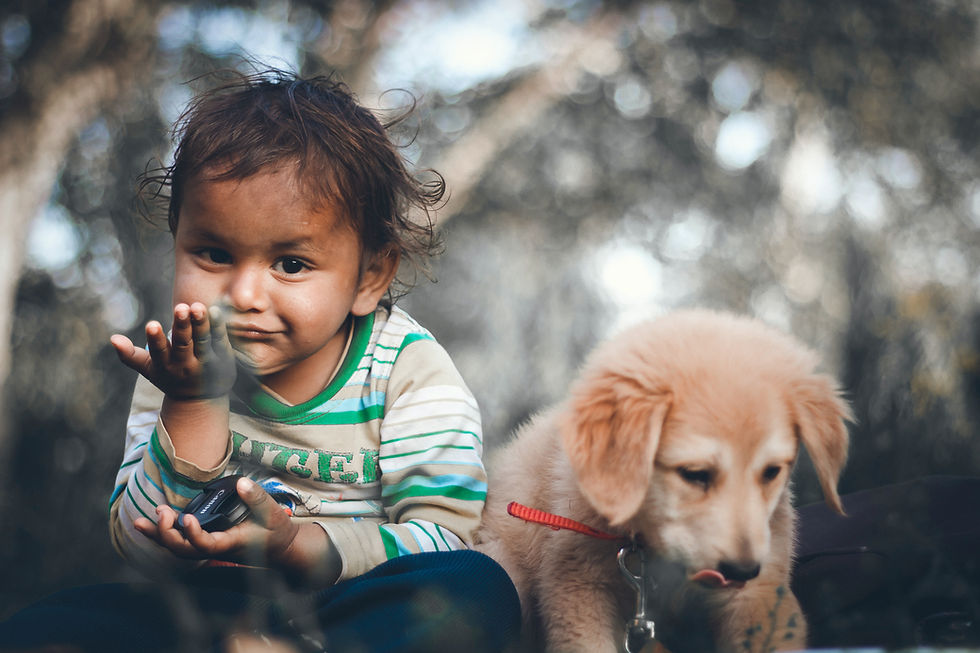
It's raining. The children are out in the field to play. They don't seem to bother by the rain. It's so much fun to jump in the puddles and make little castles with the mud. As parent you might get irritated by this. It's wet and cold, and you prefer to be inside. But this moment is not only moment of joy for your little one. It's also an educational moment.

Today, I'll write you about how small children (as much of the age till 99) learn from nature.
Why is nature important for children's development?
Most people know that nature is important for children. Most common knowledge is that fresh air contributes to good quality of life, and the Earth ensures that children are grounded and can recharge themselves.
But children also learn a great deal from nature. Children are still much more open than adults and remain more connected to the energy around them. This means that children can 'communicate' with all the energy surrounding them, including puddles and mud.
What can children learn from natural materials?
Every material contains its own energy and therefore its own information. Broadly speaking, materials can be divided into three groups in terms of energy: natural materials, semi-natural materials, and manufactured materials.
Natural materials consist of natural energy. Children's bodies are energetically built in such a way that their energy 'matches' with the energy of natural materials. This means that when touching natural materials, children form a closed energetic circuit with the material. Through this, children release their negative emotions and energy and receive positive energy in return. But the energy children receive also contains information. Depending on the sensitivity of the child, they can 'read' or 'understand' this information. For example, a child can learn about what a tree has experienced.
Semi-natural materials are natural materials that have been processed, such as paper, cardboard, plywood, glass, etc. These materials also contain natural energy, but it can no longer flow freely. It's a distorted energy. Children can connect with this energy, but they have difficulty forming a closed circuit or receiving the right information.
Manufactured materials, such as plastic, concrete, asphalt, etc., possess energy that is foreign to children and is also 'trapped.' For children, it's a kind of dead energy with which they cannot interact. Surrounding by this elements can feel very uncomfortable and lonely for children. It feels like they living alone in a death world.
Creating the Right Environment
To have a good environment for small children, they need as many natural materials as possible. This can be inside the home (wooden floors, tiles, wooden toys, wooden beds and furniture), but also the house itself (insulation, floors, walls) and streets (sand paths and shell paths, green zones, green gardens).
This makes a huge difference for children. They feel healthier, safer, more confident, more connected to the world around them and therefore never feel alone. They are always connected to the life around them.
What Can Children Learn from Nature?
The more consciously children learn to communicate with nature, the more they can learn from it. In principle, all knowledge on Earth is stored in nature.
For example, the air holds information about the weather and the energy of the day. Birds tell about the time of day and give growth energy. Trees tell their history. Water tells stories about emotions. And the horizon reveals what lies beyond it. Of course, nature is not communicating with words, but with energy. If children learn to listen to that energy more and better, they have acces to a bunch of knowledge.
Other interesting blogs
This is one blog in a series of five about how small children learn (and big children up to 99 years old, for that matter). I'll also share more about learning and nature, learning through energetic bonds, learning before and during pregnancy, learning through time travel and dimensions, and learning from animals.


Comments